

My story in teaching and education begins similar to so many teachers’ stories: I graduated at 22, completed my PGCE and then went straight into teaching English. Since then, it has been a pretty linear career pathway up until a year ago. I credit this to many of my mentors, coaches and sponsors along the way. However, the person who initiated it all was my Newly Qualified Teacher (NQT) mentor, Teresa Dunseith. In a mentor meeting, Teresa asked me what I wanted to be doing in my career in 10 years’ time; I responded that I wanted to be like her – a fantastic English teacher and Advanced Skills Teaching supporting and inspiring others to enhance their practice for student impact. Teresa then helped me map out my path to my dream role, which we researched and decided was Lead Practitioner (as Advanced Skills Teacher roles were being phased out).
A pivotal piece of advice my mentor shared with me was that in order to become a Lead Practitioner, I needed to build and hone my classroom practice, expertise and knowledge to ensure credibility in the role. She explained that by developing my knowledge, trialling evidence-informed strategies in my own classroom and evidencing the impact of these on student outcomes, I was more likely to successfully achieve buy-in from staff and students alike.
Following this advice and let’s be honest, because I loved geeking out about it, I spent hours and hours reading many books, blogs and articles; I attended multiple subject specific CPD like Shakespeare CPD at the Globe Theatre and the London Association for the Teaching of English (LATE) annual conference. I would then try the strategies in my classroom and review and discuss the impact of them in my mentor meeting with Teresa.
Along with my mentor, I started to see the difference the theoretical knowledge was having on my classroom pedagogy and practice. For example, where I once struggled with managing student behaviour and establishing routines in my classroom, I found strength in following some of Doug Lemov’s strategies in his book ‘Teach Like a Champion’. Where I found it challenging to manage different student voices in my classroom, I implemented my reading from Robin Alexander’s Dialogic Teaching to lead socratic seminars where every student had a role and opportunity to share their ideas.
The more I read, learned and developed, the more I fell in love with teaching and learning.
By the end of my time at my first school, my mentor had persuaded me to share my practice with other NQTs and deliver two whole school CPD sessions around supporting SEND students and promoting reading for pleasure across the school. As a result of this, by the end of my NQT year, I had been promoted to whole school enrichment coordinator.
The reason I share this is because many people have asked me how I have been able to take the leap into this new world of consultancy work, particularly as a hijab wearing British South Asian woman. As many who are in this space will recognise, this did not just happen overnight.
It started all those years ago with my expert mentor helping to shape my thinking and practice and advocating for me. It was Teresa who inspired my love for leading teaching and learning all those years ago!
My Career Timeline
In figure one, you can see my somewhat linear career timeline: English teacher, enrichment coordinator, English second in charge, Lead Practitioner, Assistant Headteacher and Deputy Headteacher.
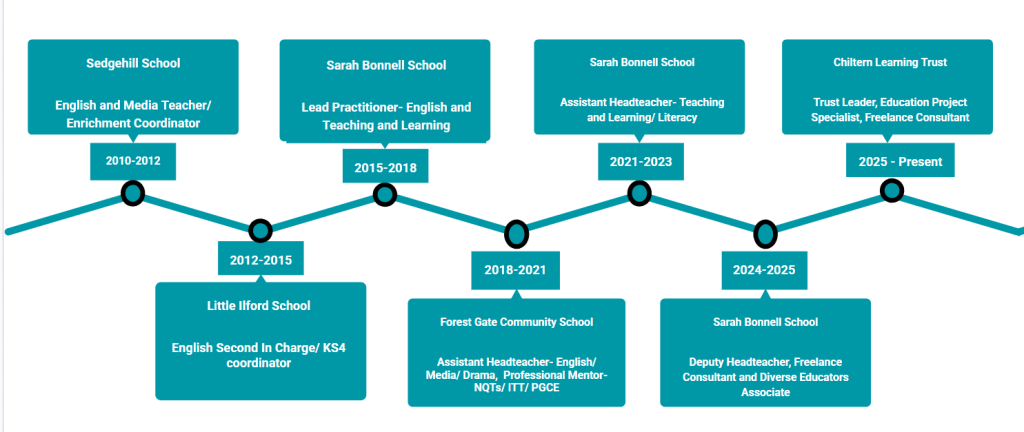
Figure 1: my career timeline
What this does not tell you is the ‘behind the scenes’ work I was doing to continually reflect, hone and enhance my knowledge beyond my classroom. I kept reading, attending conferences and trailing ideas to ensure it was being applied to impact my students.
When I joined the platform X formerly known as Twitter, to mostly follow Ed Sheeran, I found a different community altogether, the ‘edutwitter’ community and particularly #TeamEnglish. I engaged with English teachers who were generously sharing their resources for free. I was in awe of them, for their kindness and their confidence in sharing their work.
I slowly started to feel confident enough to do the same. I began by sharing my lesson resources and engaging with the conversation and ideas other English teachers were sharing on Twitter. Due to how well received my resources were, I started my own blog page https://msybeebs.wordpress.com/ to write about my teaching and leadership. Powerfully, this blog which I thought were just my ramblings, is actually what led to my publisher and editor Delayna Spencer from Sage Corwin approaching me to write my book.
Through edutwitter, I also found the wider networks that have empowered me to be 10% braver such as WomenEd. As a result of this, my obsession (it’s the only way to describe it) with reading, learning and implementing evidence–informed practice, I became a Lead Practitioner within 5 years of my career, rather than the 10 years I had originally planned with my mentor in my first year of teaching. What I also found were many people, particularly women and people from global majority heritage, who were supportive and empathetic.
Building Competence and Credibility
Throughout my time as a middle and senior school leader, I continued to develop my classroom practice as well as my leadership. I have spent most of my career either asking schools to invest in me, for example, by funding Lead Practitioner accreditation, coaching qualifications or the NPQSL or I have invested in myself by self funding learning such as my Masters in Teaching or attending national conferences like ResearchEd.
As I became more confident within my own practice, supported by student outcomes, I became braver in sharing my ideas more openly through my networks. What I found was a community with the mindset of collaboration over competition. The more I shared, the more colleagues supported me whilst also challenging me.
This led to me feeling courageous enough to speak at ResearchEd conferences across the country a few years ago, which connected me with many like-minded colleagues. Meeting and learning from ‘edugiants’ like Mary Myatt, Jennifer Webb and Tom Sherrington has been instrumental in leading the work I do now.
As a result of their advocacy and the advocacy of many others in this education consultancy and CPD space like Sufian Sadiq and Hannah Wilson, I was able to take the very scary leap from school leadership to consultancy.
I love being a teacher and senior leader on the ground but when I became a Deputy Headteacher, I realised that I wanted to have an impact on the wider education system across the country, particularly for staff and students from diverse backgrounds.
It is with the support of the different connections and communities I have built over the years in the sector and (I hope) the reputation of leading effective teaching and learning, I was able to make a decision to live my values and make the jump.
Since making that jump from school leadership to consultancy from January 2025, I have worked with multiple schools and Multi-Academy Trusts nationally to deliver professional development for staff and educators on a wide range of impactful strategies including CPD Metacognition and Independent learning, developed a mental health pastoral curriculum for Chiltern Learning Trust, delivered ECT training and been invited as a keynote speaker for different national MATs and organisations like Aspiring Heads.
Alongside my consultancy, I am also a project manager for the Mission 44 funded Increasing Diversity in Initial Teacher Training (ITT) project in partnership with Being Luminary, Chartered College of Teaching and Chiltern Learning Trust. The project seeks to actively increase the proportion of global majority teachers in ITT and beyond by working across the sector to challenge and address the systemic racism faced by trainee teachers. This role has been incredibly rewarding as I have been able to work alongside ITT providers and DEI coaches, worked on developing an online course with sector experts and coached global majority leaders as they complete their Chartered Teachers (Leadership) Pathways with Chartered College of Teaching.
My Mission
Although my work is varied and provides me with flexibility, what I hope you will see is that each portfolio of work is about removing barriers for adults and young people so that they can thrive academically and socially in schools.
I think this is why I have been so drawn to the work of PGS because they also have similar values and vision to empower young people. When I first met founder Richard at a Belonging Effect (then known as Diverse Educators) Conference in London in 2025, I was inspired by the work he and his team do to unlock potential in every child.
By providing mentoring and pastoral support in school, PGS helps the young people they intentionally work with to also thrive inside and beyond school.
So, though it was initially frightening to move from the classroom to consultancy last year, it has given me the opportunity to meet colleagues, like Richard Ige, doing some phenomenal work in schools with an aligned mission and approach to my own. Despite not being in the classroom every day as a teacher, I hope that I am now in service to the work that teachers, educators and young people do in the education sector.